As AI search captures an increasingly significant share of high-intent user queries — a trend accelerating across every industry vertical — the question for marketing leaders is no longer whether to invest in AI search optimization, but how much, when, and in what sequence. This guide provides a practical, evidence-based framework for budgeting AI search optimization investment, covering allocation percentages, cost benchmarks against traditional channels, what different budget tiers unlock, and realistic ROI expectations across 30, 90, and 180-day horizons.
The Strategic Case for Rebalancing Your Marketing Budget
The shift of user search behavior toward AI-mediated answers is not a speculative future trend — it is a present-tense revenue event. Research conducted across multiple industry verticals consistently shows that AI search tools (ChatGPT, Perplexity, Google AI Overviews) are now handling a meaningful fraction of informational and consideration-stage queries that previously arrived at websites via traditional organic search. For brands in B2B SaaS, professional services, financial products, and health-adjacent ecommerce, the concentration of AI search queries at the high-intent end of the funnel makes the category particularly consequential: these are exactly the queries where buyers are close to a decision and are using AI assistants to shortlist providers. A brand that is not cited in these responses is effectively invisible to this buyer segment.
The appropriate strategic response is not to abandon traditional SEO — organic Google results remain important and will for the foreseeable future — but to establish a parallel investment stream in AI search visibility that grows proportionally with the channel’s share of overall search traffic. This is not a replacement budget; it is an expansion into a channel with significant first-mover advantage while competitive intensity remains lower than it will be in 24 months. The brands that allocate meaningfully to AI search optimization now will be building citation authority that compounds over time, in the same way that early investments in SEO in the mid-2000s built durable organic visibility. Before committing budget, establish your baseline with a GEO Audit to understand your current generative engine visibility position and prioritize the highest-impact investment areas.
How Much of Your Marketing Budget Should Go to AI Search?
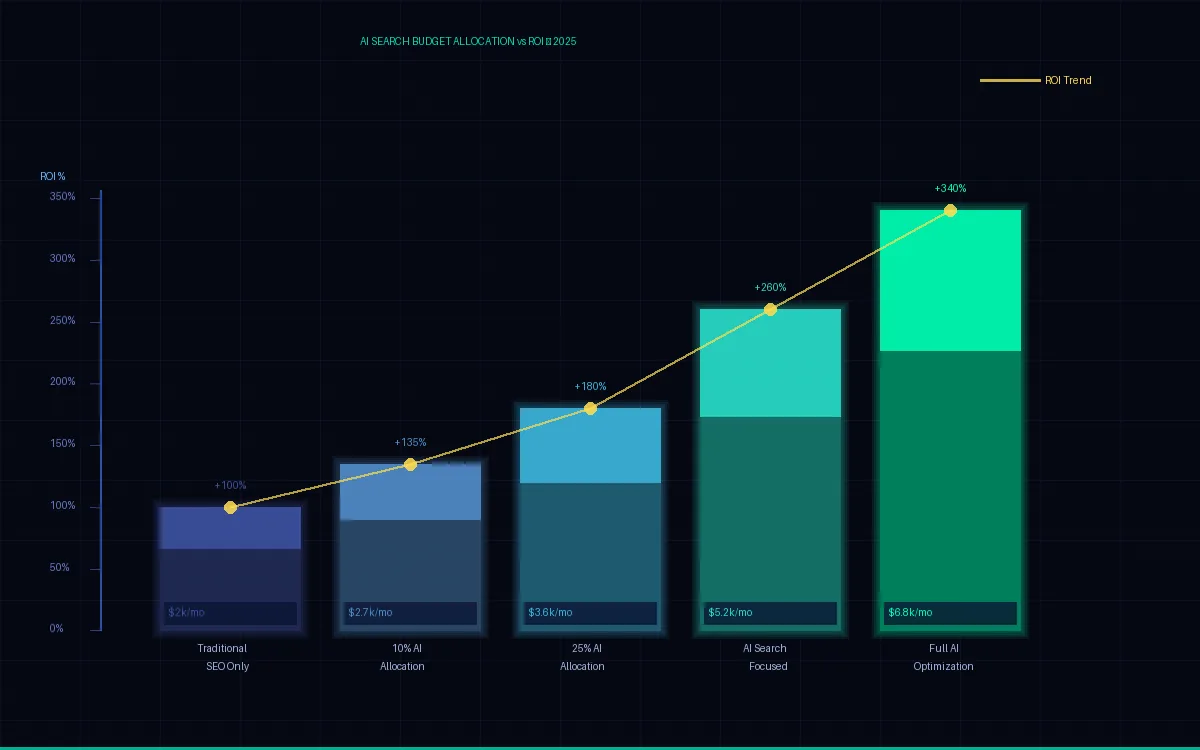
For most brands, a reasonable starting allocation is 15–25% of the existing digital marketing budget redirected toward AI search optimization over the next 12 months. This range reflects the current maturity of AI search as a traffic channel — significant enough to warrant serious investment, but not yet dominant enough to justify wholesale reallocation away from established channels. The optimal allocation varies by business type. B2B SaaS companies with long sales cycles and high CAC should lean toward the higher end of this range because AI search tools are heavily integrated into the research phase of enterprise software buying journeys. Ecommerce brands selling consumer goods should start at the lower end and scale investment based on observed citation rates in product category queries. Professional service firms (legal, financial, consulting) often justify allocation at or above 25% because AI assistant usage among professional buyers is particularly high.
For brands with existing SEO retainers in the $3,000–$10,000/month range, the practical implementation of this allocation looks like adding $500–$2,500/month in AI search optimization spend, structured as a fixed-price managed package rather than an open-ended retainer. Our monthly AI search packages are specifically designed to be additive to existing marketing budgets without requiring you to dismantle established programs that are still performing.
Cost Comparison: AI Search vs. Traditional Channels
Understanding the relative cost-efficiency of AI search optimization requires comparing it against the alternatives on a per-outcome basis, not just on absolute spend.
Traditional SEO ($2,000–$8,000/month): Enterprise SEO retainers typically deliver results over a 6–12 month horizon, with ranking improvements in competitive verticals often taking longer. The cost-per-incremental-qualified-visitor is high and continues to rise as competitive intensity increases. The channel is also increasingly subject to AI Overview displacement — Google’s own generative answer layer now absorbs clicks that would previously have reached organic results.
Google Ads (variable, typically $5–$50+ CPC): Paid search delivers traffic immediately but stops the moment you stop paying. For high-intent B2B keywords, CPCs of $20–$80 are common. A brand achieving 500 qualified visits per month from paid search at $25 CPC is spending $12,500 per month on traffic that generates zero compounding value. By contrast, AI search citations — once earned — persist as part of the ongoing AI training corpus and accumulate authority over time.
AI Search Optimization ($99–$3,000/month depending on scope): The key economic advantage of AI search optimization is its compounding return structure. Citations earned through entity building, corpus seeding, and structured content optimization persist and strengthen over time. The investment creates durable brand presence in AI responses rather than rented traffic that evaporates. For brands with limited budgets, our entry-level packages starting at $99 deliver a structured starting point — an AI Search Audit and prioritized action plan — that provides immediate clarity on where to focus resources for maximum early impact.
What Different Budget Tiers Unlock
AI search optimization investment is not a single product; it is a layered capability build that scales with budget. Understanding what each investment level activates helps marketing leaders set realistic expectations and design appropriate success metrics for each engagement phase.
- $99–$299/month (Audit & Foundation): At this level, the primary deliverable is a comprehensive baseline measurement and prioritized opportunity map. You’ll receive an AI Search Audit covering your current citation rate across 5 major platforms, competitor citation analysis, entity gap assessment, schema coverage review, and a structured 90-day improvement roadmap. This tier is ideal for brands at the start of their AI search journey who need to understand where they stand before committing to ongoing optimization spend.
- $300–$799/month (Active Optimization): This tier unlocks managed content optimization — restructuring existing pages for AI retrieval compatibility, implementing targeted FAQ and structured answer blocks, schema markup implementation, and monthly citation monitoring with reporting. Brands at this level typically see measurable citation lift within 60–90 days across 1–2 target platforms.
- $800–$1,999/month (Multi-Platform Growth): Full multi-platform citation building across all five major AI engines, entity building through targeted digital PR placements, topical cluster development, and competitive displacement targeting. Brands at this tier build defensible citation positions across their full keyword universe within 90–180 days.
- $2,000+/month (Market Leadership): Comprehensive corpus seeding, aggressive entity authority building, monthly digital PR campaigns in tier-1 publications, white-glove reporting, and dedicated strategy access. This tier is appropriate for brands in competitive verticals where AI search citation leadership directly translates to high-value customer acquisition. Explore our full monthly packages and AI search pricing guide for detailed tier breakdowns.
ROI Expectations Across Time Horizons
AI search optimization ROI manifests differently from paid channel ROI. There is no instantaneous traffic switch; instead, the return curve is gradual then accelerating. In the first 30 days, investment primarily purchases measurement infrastructure and strategic clarity — understanding where citations exist, where they’re absent, and which interventions will produce the fastest lift. From 30–90 days, active optimization work begins generating initial citation improvements, with brands typically moving from zero to low-frequency mentions for their primary target queries. From 90–180 days, compounding effects become visible: citations become consistent rather than occasional, competitive displacement begins, and AI engine responses start reliably positioning the brand alongside or ahead of previously dominant competitors. Beyond 180 days, the economic case becomes compelling: brands with established AI citation authority see consistent inbound traffic from AI referrals, reduced dependence on paid search for awareness-stage coverage, and defensible brand positioning that competitors cannot quickly replicate.
ROI measurement should be structured around citation rate (mentions per 100 target prompts), citation sentiment (whether the characterization is favorable), citation context (are you mentioned as a leader, an alternative, or a footnote), and downstream traffic (referral visits from AI platforms with clear UTM attribution). Brands that measure these metrics rigorously from the outset of their investment are consistently able to demonstrate clear ROI to CMOs and CFOs within two quarters.
Getting Started with a Limited Budget
The most common barrier we encounter from marketing leaders considering AI search investment is not skepticism about the channel — most accept that AI search is important — but uncertainty about how to allocate a limited budget effectively. The practical answer is sequenced investment: start with measurement, then optimize for the highest-impact opportunities first, then scale.
Step one is always a GEO Audit — a comprehensive assessment of your current AI search visibility position that identifies exactly where you have citation gaps, which competitors are outperforming you, and which specific interventions would produce the fastest measurable lift. This audit costs a fraction of a month’s traditional SEO retainer and provides the strategic foundation for every optimization decision that follows. Armed with audit findings, step two is targeted optimization work on the highest-priority opportunities — typically the 3–5 query clusters where your brand is closest to appearing in AI responses but is not yet being reliably cited. This focused approach delivers faster measurable results than broad-front optimization campaigns and maximizes the return on early-stage budget. As citation rates improve and the business case becomes clear to stakeholders, budget can be increased to expand platform coverage, deepen entity authority building, and extend the brand’s AI citation footprint to more competitive query categories. Every dollar invested in AI search optimization at this early stage of channel maturity purchases advantage that will be significantly more expensive to acquire as the channel becomes more competitive in the years ahead.
Frequently Asked Questions