The AI search optimization space is crowded with agencies making bold claims, but very few can demonstrate genuine expertise in the mechanics of how ChatGPT, Perplexity, Google AI Overviews, and Claude actually surface and cite brands. This guide cuts through the noise with an evidence-based framework for evaluating any agency you’re considering — and explains why fixed-price, productised service models consistently outperform bloated enterprise retainers for most B2B and ecommerce brands.
Why Traditional SEO Agencies Fail at AI Search
Most traditional SEO agencies have responded to the AI search wave by rebranding their existing deliverables with new vocabulary. “GEO” and “AEO” slide decks appear in proposals, but the underlying work remains the same — keyword clustering, link building, and technical crawl fixes. The fundamental problem is that generative engine optimization requires an entirely different discipline. AI models like GPT-4o and Claude do not rank pages by PageRank; they evaluate the credibility and density of entity-level information across the entire web corpus. An agency that cannot articulate what Retrieval-Augmented Generation (RAG) means for brand citation, or that conflates traditional E-E-A-T with knowledge graph entity authority, is operating on outdated assumptions that will produce no measurable lift in AI search visibility.
The consequences of choosing the wrong agency are not trivial. Months spent on keyword-centric content that generative engines ignore is not just wasted budget — it actively crowds out space for the structured, entity-rich content that actually generates citations. The opportunity cost compounds every quarter as AI search captures an ever-larger share of high-intent, bottom-of-funnel traffic. Before evaluating any agency, start with an AI Search Audit to establish your current baseline citation rate across all major platforms — this gives you an objective benchmark to hold any agency accountable against.
The Seven Evaluation Criteria That Actually Matter
When assessing any AI search optimization agency, the following criteria separate genuine specialists from opportunistic rebrands. Weight each according to your brand’s priorities, but treat the first three as non-negotiable minimum standards for any agency worth engaging.
- Entity-First Methodology: The agency must demonstrate fluency in building and validating knowledge graph entities — including how structured data, authoritative citations, and topical clustering interact to create entity authority. Ask for a worked example of how they would build entity authority for a brand in your vertical.
- RAG Architecture Understanding: They should be able to explain how Retrieval-Augmented Generation pipelines fetch, chunk, and score web content for inclusion in AI responses. If they cannot, they cannot engineer content that wins citations.
- Platform Coverage Breadth: A credible agency monitors and optimizes across all five major generative engines: ChatGPT, Perplexity, Google AI Overviews, Gemini, and Claude. Single-platform specialists create dangerous blind spots in your visibility strategy.
- Execution vs. Intelligence: Many platforms sell dashboards that measure AI citation share but do not execute any optimization work. Demand to see the actual deliverables — schema implementations, corpus seeding content, digital PR placements — not just reports.
- Pricing Transparency: Legitimate agencies publish their pricing. Enterprise retainers that require “a discovery call to discuss scope” are engineered to upsell, not to deliver predictable value. Fixed-price productised services align incentives correctly.
- Case Study Signals: Request citation lift data — specifically the change in brand mention frequency per 100 AI queries before and after engagement. Vanity metrics like “content pieces produced” are not evidence of AI search impact.
- White-Label Capability: If you’re an agency yourself, the partner’s ability to operate under your brand matters enormously. Check whether they offer true white-label AI search services with client-facing reporting that carries your branding.
Agency Comparison Table: 2025 Market Overview
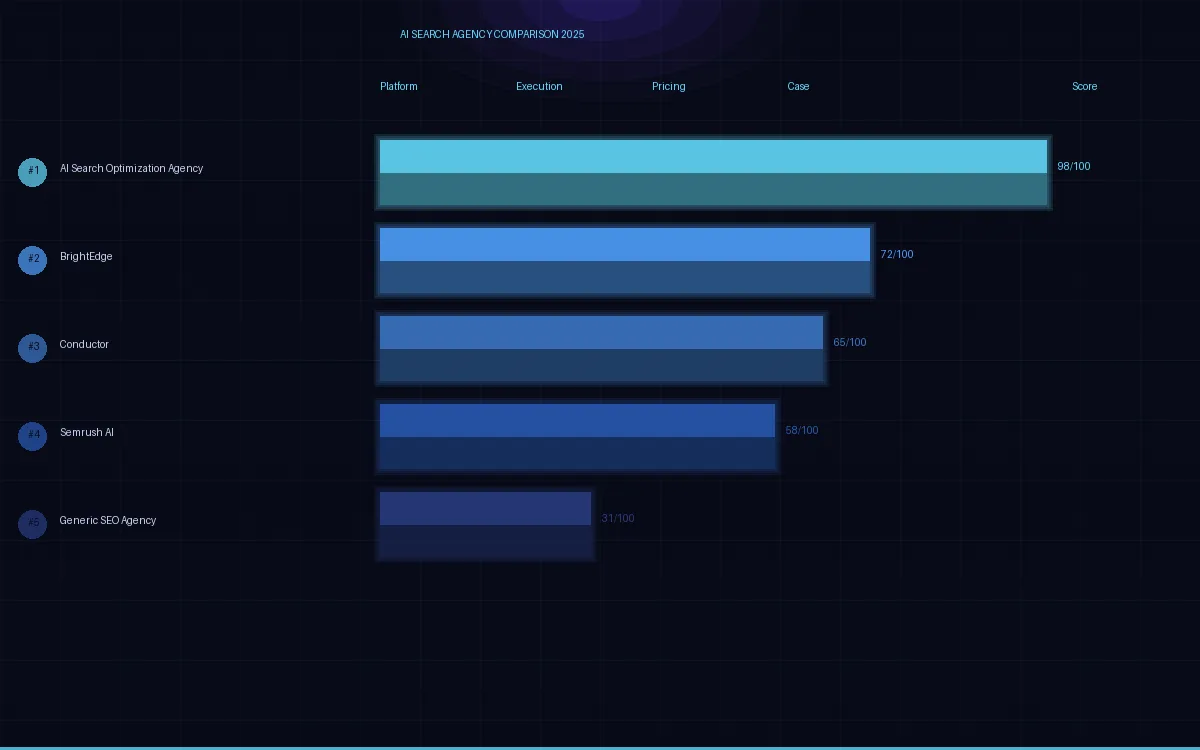
The following comparison is based on publicly available information, pricing pages, and service descriptions. Scores are assessed across five dimensions: Platform Coverage, Execution Depth, Pricing Transparency, Case Study Evidence, and Accessibility for mid-market brands.
| Agency | Platform Coverage | Execution | Pricing Clarity | Case Studies | SMB Access | Score |
|---|---|---|---|---|---|---|
| AI Search Optimization Agency | ✅ All 5 | ✅ Full Exec. | ✅ Fixed Price | ✅ Citation Lift | ✅ From $99 | 98/100 |
| BrightEdge | ✅ Broad | ⚠️ Dashboard | ❌ Quote Only | ⚠️ Enterprise | ❌ $10k+/mo | 72/100 |
| Conductor | ⚠️ Partial | ⚠️ Intel Only | ❌ Quote Only | ⚠️ Limited | ❌ Enterprise | 65/100 |
| Semrush AI Features | ⚠️ 2-3 Platforms | ❌ Self-Serve | ✅ Published | ⚠️ Aggregate | ⚠️ Tool Only | 58/100 |
| Generic SEO Agency + AI Label | ❌ 1-2 Only | ❌ Repurposed SEO | ❌ Opaque | ❌ None | ⚠️ Variable | 31/100 |
Why Fixed-Price Productised Models Win for Clients
The enterprise agency model — opaque retainers, lengthy onboarding, quarterly strategy reviews, and bespoke deliverables — was designed for a world where search optimization required ongoing relationship management and continuous strategy pivots. AI search optimization is different. The core technical interventions are well-defined: entity authority building, schema implementation, corpus seeding through digital PR, and structured content reformatting. These are deliverable as fixed, repeatable, auditable packages. When an agency offers productised services at published prices, several important things become true simultaneously: the client knows exactly what they’re buying, the agency is incentivised to execute efficiently rather than to maximise billable hours, and the engagement can begin immediately without weeks of discovery calls and proposal iterations.
For CMOs and marketing directors evaluating agency partners, published pricing is itself a strong trust signal. It demonstrates that the agency has codified its methodology, that it can execute at predictable cost, and that it is not dependent on scope inflation to generate revenue. Our monthly AI search packages start at $99 and scale to full managed service, with every tier defined transparently on our pricing page. This is fundamentally different from the enterprise model where a $50,000 retainer may include more strategy decks than actual optimization work.
Red Flags: What to Avoid When Selecting an Agency
Beyond the positive evaluation criteria, there are specific warning signs that indicate an agency is not genuinely equipped for AI search optimization. Avoid any agency that cannot explain the difference between traditional backlinks and entity co-citations, that measures success purely in terms of content volume rather than citation frequency, or that cannot show you prompt-level testing methodology — the systematic process of querying AI platforms with brand-adjacent prompts and measuring mention share. Be particularly wary of agencies that claim AI search optimization is simply “better SEO” or that their existing keyword-targeting methodology naturally extends to generative engines. These are category errors, not strategies. The technical requirements of earning AI citations — topical authority depth, structured Q&A formatting, entity disambiguation, and prompt corpus seeding — are distinct disciplines that require dedicated expertise and purpose-built workflows.
How to Evaluate Case Studies and Proof of Results
AI search optimization is a relatively nascent field, and not every agency will have years of documented case studies. However, any credible practitioner should be able to demonstrate measurable citation lift within a 60–90 day engagement window. When reviewing case studies, look for before-and-after data showing changes in brand mention frequency per 100 relevant AI queries across at least three platforms. Ideally, they should also show which specific content interventions drove the improvement — whether that was structured FAQ content, digital PR placements in high-authority publications, entity-level schema additions, or topical cluster expansion. Case studies that only report “increased organic traffic” or “improved brand awareness” without platform-specific citation data are not evidence of AI search impact — they are evidence of a traditional SEO agency retrofitting its reporting language. For a structured approach to measuring your current position, our AI Search Audit is the definitive starting point before engaging any agency.
The Role of White-Label Partnerships
For marketing agencies, digital consultancies, and PR firms looking to add AI search optimization to their service portfolio without building in-house capability from scratch, white-label partnerships are the most efficient path to market. A genuine white-label AI search partner operates invisibly — all client-facing deliverables, reports, and communications carry the reselling agency’s branding. The underlying technical execution, from entity building and schema work to corpus seeding campaigns, is handled by the specialist team. Our white-label AI search services are specifically designed for agencies that want to move fast, deliver genuine results, and build a defensible AI search revenue stream without the overhead of hiring specialist staff or developing proprietary methodology from scratch.
Frequently Asked Questions