Your existing pages are already indexed, already trusted in some measure by search engines, and already earning traffic, but they are invisible to AI. AI Search Content Optimisation restructures those pages so every major generative model can extract, attribute, and cite your content with confidence. Unlike creating new content from scratch, optimisation works with what you already have, layering in the AEO and GEO citation signals that determine whether ChatGPT, Perplexity, Gemini, AI Overviews, Copilot, and Claude choose your page as a source. Start with an AI search audit to identify which pages need optimisation first, then let us restructure them for maximum citation across all six platforms.
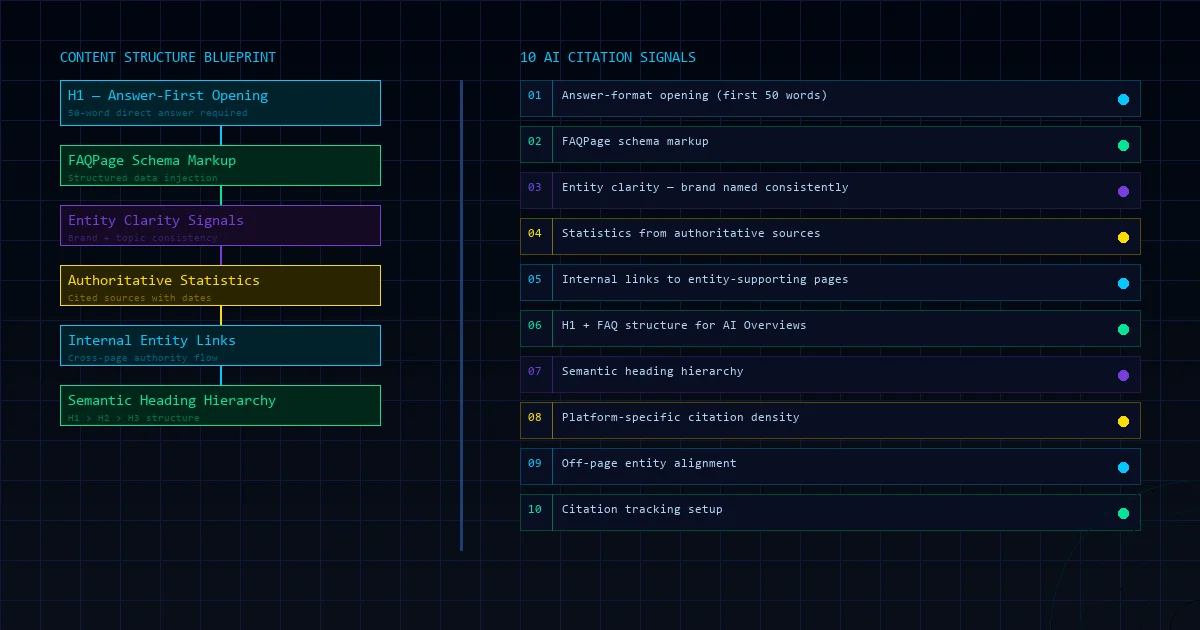
The 10 AI Search Content Optimisation Signals
Our optimisation framework is built around ten proven citation signals drawn from both Answer Engine Optimisation (AEO) and Generative Engine Optimisation (GEO) methodologies. Each signal addresses a specific way in which AI platforms retrieve and evaluate content. Applying all ten in a single optimisation pass is what transforms a page from an ignored source into one that earns consistent AI citations across multiple platforms simultaneously. See our detailed optimisation techniques guide for the full technical breakdown behind each signal.
- Answer-format opening (first 50 words): AI platforms retrieve the most extractable content first. Pages that open with a direct, complete answer to their primary question are cited at significantly higher rates than pages that bury the answer after introductory paragraphs. We restructure every page so the first 50 words deliver a quotable, standalone answer.
- FAQPage schema markup: Structured data using FAQPage schema directly communicates question-answer pairs to AI systems. Google AI Overviews and Gemini use this signal explicitly. We implement valid JSON-LD schema on every page and verify it against the latest structured data standards.
- Entity clarity, brand named consistently: If your brand name appears in multiple formats across a page, abbreviated, hyphenated, or with slight variations, AI systems struggle to assign citations with confidence. We enforce consistent entity naming throughout the content, headings, schema, and metadata.
- Statistics from authoritative sources: Perplexity and ChatGPT both favour content that cites verifiable statistics from named, reputable sources. We identify the highest-impact data points relevant to your topic and integrate properly attributed statistics that increase a page’s citation credibility.
- Internal links to entity-supporting pages: AI platforms follow topical authority signals across a site. Internal links to your core entity pages, your about, services, and topic cluster pages, reinforce the topical associations that help models understand your brand’s expertise scope.
- H1 + FAQ structure for AI Overviews: Google AI Overviews specifically prioritises pages with a matching H1 that includes the primary query term, followed by FAQ-format content. We restructure headings to match AI Overviews’ retrieval preferences without sacrificing the page’s quality for human readers.
- Semantic heading hierarchy: A clean H1 > H2 > H3 hierarchy is essential for AI content extraction. Broken heading structures, skipped levels, keyword-stuffed headings, or missing H1 tags, significantly reduce citation probability. We rebuild every page’s heading architecture from scratch.
- Platform-specific citation density: Different AI platforms extract content at different passage lengths. ChatGPT typically retrieves passages of 100–200 words. Perplexity prefers shorter, denser factual statements. We calibrate the information density of each section to maximise citation probability across the specific platforms most relevant to your buyer research behaviour.
- Off-page entity alignment: On-page optimisation only works if it is consistent with the entity signals that exist off-site. We audit your off-page entity profile and flag any misalignments between how your brand describes itself on-site and how it is described in third-party citations, reviews, and industry directories.
- Citation tracking setup: Optimisation without measurement is guesswork. We configure a citation tracking baseline so you can monitor which pages are being cited by which platforms after optimisation, enabling you to identify what is working and prioritise the next round of fixes.
How the Optimisation Process Works
Every optimisation project follows a structured three-stage process designed to deliver ready-to-publish pages rather than recommendations you have to implement yourself. In stage one, we conduct a pre-optimisation assessment of your submitted pages, scoring each against all ten citation signals and identifying the highest-priority structural issues. This assessment determines the sequencing of fixes and ensures that the highest-ROI changes happen first. In stage two, our specialists rewrite and restructure each page by hand. This is not an AI-generated rewrite, it is a manual content restructuring process that preserves your brand voice, updates the factual accuracy of your content, and applies all ten citation signals in a way that reads naturally for human visitors while being engineered for AI extraction. In stage three, we deliver the fully optimised pages alongside a change report that documents every modification made and the citation signal each change addresses. This makes the work fully auditable by your editorial team and provides clear context for any platform-specific fixes that your team may want to apply to similar pages independently.
AEO + GEO Signals: Why Both Matter
Content optimisation services that focus solely on AEO signals (schema markup and answer formatting) or solely on GEO signals (entity density and citation source alignment) will consistently underperform against a combined approach. AEO signals are primarily read by Google AI Overviews and are deeply influenced by the structured data standards developed for Google’s rich results ecosystem. GEO signals are primarily read by ChatGPT, Perplexity, and Claude, systems that rely on semantic understanding, topical authority, and source trust rather than schema alone. Applying both in a single optimisation pass means one restructured page can earn citations from multiple platforms simultaneously. Our framework was built from the ground up to deliver this dual-signal approach on every page, regardless of which tier you choose. This is the core technical difference between a true AI search optimisation service and a legacy AEO service that has added “GEO” to its marketing materials without updating its methodology.
Pricing Tiers
Three fixed-price tiers cover every scale of optimisation project. The 5-Page Tier at $250 is the right entry point for most brands, it covers your highest-priority commercial pages, your top-ranking informational pages, or the cluster of pages your audit identified as the highest-impact quick wins. Turnaround is five business days. The 10-Page Tier at $450 is the most popular choice for brands that have completed their first audit and want to restructure their entire core content library. Turnaround is seven days. The 20-Page Tier at $890 is built for high-volume projects, ecommerce category pages, or SaaS feature pages where broad coverage across a topical cluster is required. Turnaround is ten days. All tiers are one-time payments ordered online without a discovery call. Ordering is self-serve, you submit your page URLs and audit findings at checkout, and work begins immediately. Consider pairing optimisation with our entity building service to simultaneously strengthen off-page citation signals while your pages are being restructured on-site.
Who This Service Is For
AI Search Content Optimisation is the right service when you already have published pages that are indexed but are receiving zero or low citation frequency in AI-generated answers. It is the natural second step after completing an AI search audit, the audit tells you which pages are invisible and why, and optimisation fixes them. Marketing teams use this service to upgrade their existing blog and resource libraries without going through a full content production cycle. SaaS companies use it to make their product comparison pages and feature pages citable in AI-generated software recommendation answers. Ecommerce brands use it to restructure category and buying guide pages for AI shopping query citations. Agencies use it as a white-label deliverable, optimised pages delivered in a format that can be presented directly to clients under the agency’s brand. Whatever your industry, if you have content that is not earning AI citations today, this service restructures it for the AI search era without discarding the SEO equity you have already built.